
SEO vs AEO vs GEO: What Is the Difference in 2026?

Mars Web Team
Technical Architecture & Marketing Team
Need Help Implementing This?
Get a personalized consultation and estimate for your project within 2 hours.
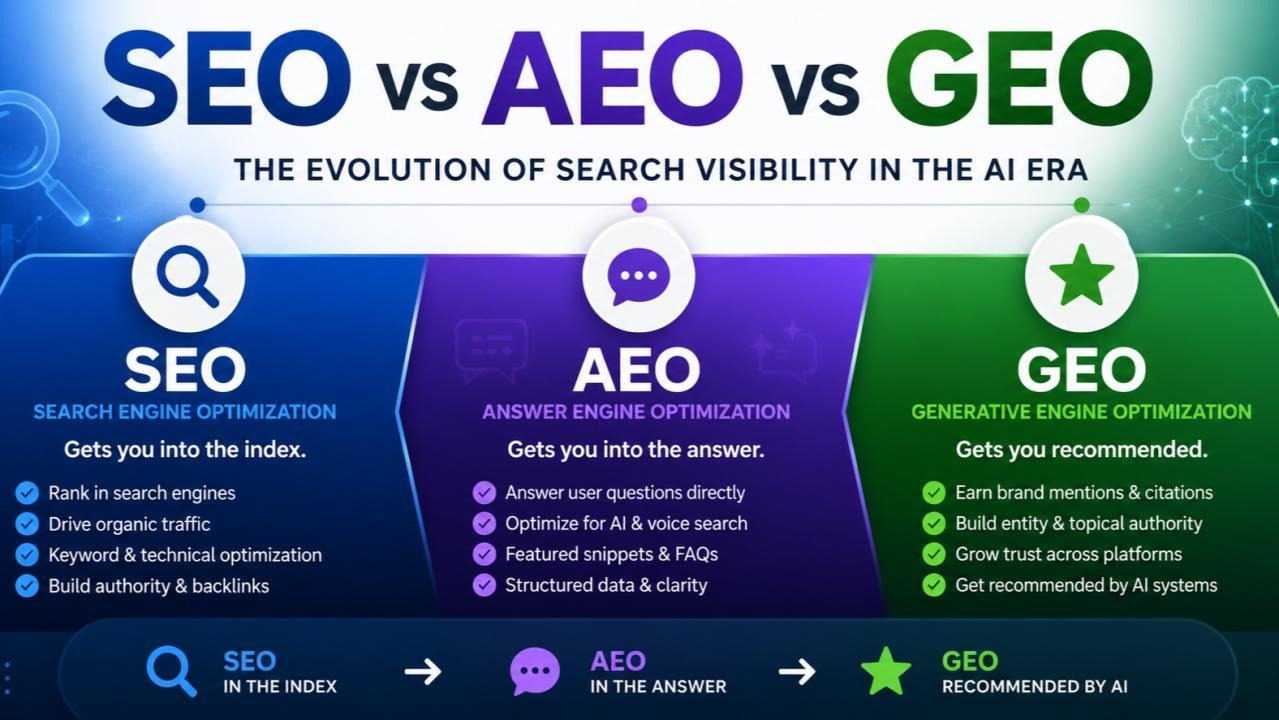
Search is changing rapidly. People are no longer using only traditional search results to find information, products, and services. They are also using featured snippets, direct answers, AI search tools, and chat-based platforms to find what they need.
This shift has introduced three commonly used terms: SEO, AEO and GEO.
SEO helps your website rank higher in search results. AEO helps your content answer users’ questions clearly. GEO helps your brand appear in AI search results and AI-generated answers.
While the terminology overlaps, the three concepts emphasize different search experiences.
For businesses investing in digital marketing in 2026, understanding SEO, AEO, and GEO can help improve online visibility across search engines and AI platforms. MARS Web Solution helps businesses improve their online presence through SEO, web development, and digital marketing solutions.
Want to improve your website’s search visibility?
Get expert SEO support from MARS Web Solution and build a strategy that helps your business reach the right audience across search engines and AI-powered platforms.
What Is SEO?
SEO, or Search Engine Optimization, is the process of improving a website so that its pages can be discovered, understood and ranked in organic search results.
Traditional SEO focuses on search engines such as Google and Bing. It involves improving technical website performance, content, relevance, internal linking, authority and user experience.
MARS Web Solution provides SEO and SEM services that include areas such as SEO page optimization, content optimization, meta tag optimization, link building, local SEO and search performance tracking.
Important areas of SEO include:
- Keyword research
- Search intent analysis
- On-page optimization
- Technical SEO
- Content optimization
- Internal linking
- Backlink development
- Local SEO
- Website performance
- Mobile optimization
- Search analytics and reporting
The primary objective is to help relevant pages become more visible when people search for related products, services or information.
What Is AEO?
AEO, or Answer Engine Optimization, focuses on creating content that gives clear and direct answers to users’ questions.
Instead of focusing only on ranking a complete webpage, AEO considers whether a specific section of that page clearly answers a question.
For example, someone might search:
What is technical SEO?
An AEO-friendly page gives a clear and direct answer near the relevant heading. It can then provide more details to help users understand the topic. Google can also show relevant parts of a webpage as featured snippets when they directly answer a user’s question.
Common AEO practices include:
- Answering questions directly
- Using descriptive question-based headings
- Providing concise definitions
- Structuring information with lists and tables
- Creating clearly separated answer sections
- Covering related questions
- Supporting claims with reliable information
- Writing content that can be understood without excessive context
AEO therefore places strong emphasis on answer clarity and content structure.
What Is GEO?
GEO, or Generative Engine Optimization, focuses on improving the chances that a brand’s useful and credible information will be discovered or referenced in AI-generated responses. It involves creating helpful content, demonstrating expertise and maintaining consistent brand information. However, no optimization strategy can guarantee citations or recommendations from AI platforms.
For example, a user might ask an AI search system:
What are the best ways for a small business to improve its online visibility?
Instead of receiving only ten webpages, the user may receive a synthesized response containing explanations and references to different sources.
GEO aims to make a business’s information more useful, understandable, trustworthy and referenceable within these experiences.
Recent research describes GEO as an area concerned with increasing the presence, citation or influence of content in answers generated by generative engines. The research also notes that the field is still developing and that measurement approaches vary.
GEO commonly involves:
- Building topical authority
- Creating original and useful content
- Demonstrating expertise and experience
- Supporting claims with evidence
- Building brand recognition
- Earning relevant mentions and links
- Improving entity clarity
- Publishing content across credible sources
- Maintaining consistent business information
- Creating content that answers real user questions
GEO should not be viewed as a replacement for SEO. Much of the underlying work still depends on having a technically accessible website and useful, authoritative content.
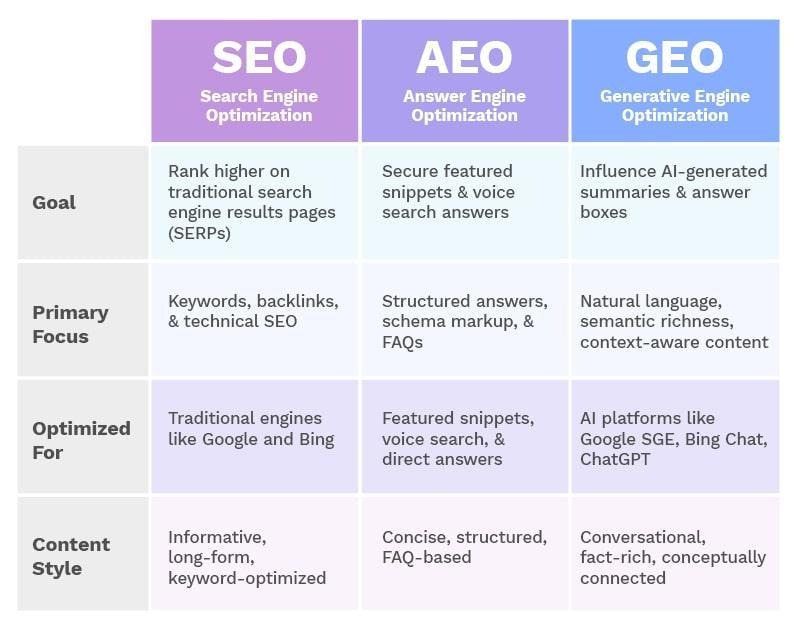
SEO vs AEO vs GEO: Key Differences
The simplest way to understand the three concepts is to look at what each one is trying to achieve.
SEO vs AEO vs GEO: An Example
Suppose a web development company publishes an article about e-commerce website development.
SEO approach
The company may optimize the page for keywords such as:
- E-commerce website development
- E-commerce website development company
- E-commerce web design
- Online store development
The page may also be optimized for technical SEO, internal linking, page speed and relevant backlinks.
AEO approach
The same page could include questions such as:
What is e-commerce website development?
A short, direct answer can appear immediately below the heading, followed by a detailed explanation.
Other sections could answer:
- How much does e-commerce website development cost?
- What features should an e-commerce website have?
- How long does it take to build an e-commerce website?
- What is the difference between custom and template-based e-commerce websites?
GEO approach
The company can strengthen the same content by providing:
- Original insights
- Clear explanations
- Demonstrable expertise
- Relevant examples
- Supporting evidence
- Clear information about the company and its services
- Consistent brand information across the web
One page can therefore be optimized for search rankings, direct answers and generative AI visibility without creating three separate pieces of content.
Does AEO Replace SEO?
No. AEO does not replace SEO.
A page still needs to be discoverable, crawlable and relevant before its information can potentially be surfaced by a search or answer system.
SEO provides the broader foundation:
- Technical accessibility
- Search intent alignment
- Content relevance
- Website structure
- Internal links
- Authority
- User experience
AEO adds another layer by making important answers easier to identify and understand.
Instead of treating SEO and AEO as competing strategies, businesses can incorporate answer-focused content into their existing SEO strategy.
Does GEO Replace SEO?
No. GEO should not be treated as a replacement for SEO either.
Generative search and AI systems still need information sources. Websites with useful, accessible and authoritative content can contribute to the information ecosystem used by these systems.
However, GEO introduces additional considerations around:
- Brand mentions
- Entity understanding
- Content authority
- Source credibility
- Citations
- Original information
- Consistent brand information
Research into GEO is still developing, and current academic work highlights variability in generative-engine retrieval, citation and visibility. Therefore, businesses should avoid treating GEO as a guaranteed ranking or citation formula.
How SEO, AEO and GEO Work Together
A practical 2026 strategy can combine all three.
1. Start with SEO
Build a technically sound website with useful content targeting relevant search intent.
Make sure search engines can crawl and understand your website.
2. Add AEO-friendly content
Identify questions your audience asks and answer them clearly.
Use:
- Question-based headings
- Short definitions
- Bullet points
- Step-by-step explanations
- Comparison tables
- FAQs where they are genuinely useful
The goal is to make important information easy to understand and extract.
3. Strengthen GEO signals
Develop content that demonstrates genuine expertise and provides useful information that other sources can reference.
Consider:
- Original research
- Expert commentary
- Case studies
- Statistics with sources
- Author information
- Expert profiles
- Industry contributions
- Relevant digital PR
- Brand mentions
- High-quality backlinks
4. Build a consistent brand entity
Make sure your business name, services, contact information, expertise and other important business details are consistent across your website and relevant third-party platforms.
This helps create a clearer digital identity around the organization.
Is your website ready for the changing search landscape?
Our SEO team can help you improve your content, website structure, and online visibility with a practical SEO, AEO, and GEO strategy.
How to Create Content for SEO, AEO and GEO in 2026
Instead of creating completely separate content strategies, businesses can create content that satisfies multiple search experiences.
A useful framework is:
Search intent → Direct answer → Detailed explanation → Evidence → Expertise → Supporting sources → Clear next step
For example:
Question
What is local SEO?
Direct answer
Local SEO is the process of improving a business’s online visibility for searches associated with a specific geographic area.
Detailed explanation
Explain Google Business Profile optimization, local landing pages, citations, reviews, local content and other relevant factors.
Evidence
Support important claims with reliable sources or first-party data.
Expertise
Add practical examples, experience, case studies or expert commentary.
Next step
Guide the reader toward a relevant service or resource.
This structure can make content useful to both people and increasingly sophisticated search interfaces.
What Should Businesses Measure?
SEO, AEO and GEO should not necessarily be measured using one single metric.
SEO metrics
Businesses can monitor:
- Organic impressions
- Organic clicks
- Keyword rankings
- Organic sessions
- Indexed pages
- Backlinks
- Conversions
- Leads
- Local search visibility
AEO metrics
Depending on the search platform and available tracking, businesses can monitor:
- Featured snippet visibility
- Answer-surface visibility
- People Also Ask visibility
- Question-based rankings
- Organic impressions and clicks from answer-focused queries
There is no universal AEO metric that perfectly captures every answer-engine experience.
GEO metrics
GEO measurement is still developing. Possible indicators include:
- AI-generated mentions
- AI citations
- Brand references
- Source inclusion
- Visibility across tracked AI prompts
- Referral traffic where identifiable
- Brand searches
- Conversion activity influenced by AI discovery
Because generative responses can vary between queries and platforms, GEO measurement should be treated as an evolving discipline rather than a single fixed ranking score.
Common SEO, AEO and GEO Mistakes
1. Treating AEO as only FAQ schema
AEO is much broader than adding FAQ markup.
Content structure, answer clarity and information quality are important parts of creating answer-friendly content.
Google’s current documentation also shows that specific search features change over time, so businesses should not build an entire strategy around one search-result format.
2. Assuming GEO means writing for AI instead of people
The objective should not be to produce unnatural content filled with keywords or artificial references.
Useful content should remain understandable and valuable to human readers.
3. Creating separate pages for every minor question
Not every question requires a new webpage.
Related questions can often be answered naturally within a comprehensive resource.
4. Focusing only on keywords
Modern search optimization requires understanding what the user actually wants.
For example:
“SEO services Bangalore”
and
“How does SEO work for a local business?”
represent different search intents and may require different content approaches.
5. Expecting guaranteed AI citations
AI-generated responses are not controlled by website owners or SEO agencies.
No legitimate optimization strategy can guarantee that a particular AI system will cite a particular page for every query.
SEO, AEO and GEO: Which One Should You Use?
For most businesses, the practical answer is all three as part of one integrated content strategy.
SEO provides the foundation for organic search visibility.
AEO helps content communicate answers clearly.
GEO considers how information may be discovered, interpreted and referenced within generative search experiences.
The three approaches overlap considerably, so businesses do not necessarily need three separate teams, three separate websites or three separate content strategies.
Instead, focus on creating a technically accessible website with useful, well-structured, authoritative and genuinely helpful content.
The Future of Search Is Not Just About Rankings
Search visibility in 2026 is broader than achieving a position on a traditional results page.
Users may discover a business through:
- Organic search results
- Local search
- Featured answers
- People Also Ask
- AI-generated responses
- Brand mentions
- Third-party publications
- Reviews and other digital platforms
This means businesses need to think beyond “How do I rank this page?”
A better question is:
“How can we make our business the most useful and credible source for this topic across the places where our customers search?”
That is where SEO, AEO and GEO come together.
How MARS Web Solution Can Help
MARS Web Solution provides web design, web development, e-commerce, software development and SEO/SEM services. Its SEO services include areas such as content optimization, on-page optimization, link building, local SEO and search performance tracking.
As search continues to evolve, businesses can benefit from an integrated approach that combines a technically strong website with useful content, search optimization and a clear digital presence.
If your business wants to improve its visibility across traditional search and emerging AI-driven search experiences, start by auditing your existing website, content and search performance.
Contact MARS Web Solution to discuss your SEO and digital visibility requirements.
Final Takeaway
SEO, AEO and GEO support visibility across different search experiences. SEO provides the foundation for organic search, AEO helps users find clear answers, and GEO focuses on visibility in generative AI experiences.
Businesses should combine these approaches by maintaining a technically sound website, publishing useful and credible content, and making important information easy to understand.
Ready to grow your online visibility in 2026?
Partner with MARS Web Solution for SEO and digital marketing solutions designed to help your business stay visible as search continues to evolve.
Engineering Principles & Execution Roadmap
Turn these insights into real business growth. Follow our proven agency framework for speed, security, and search dominance.
Page Speed & User Experience
Fast pages retain more buyers and rank higher on search engines:
- Fast Server Response: Sub-second response times keep visitors engaged.
- Image Compression: Modern WebP and AVIF formats cut data load times.
- Layout Stability: Zero visual shift ensures smooth mobile reading.
Conversion Rate Optimization (CRO)
Website traffic only matters if it generates leads and sales:
- Clear Visual Hierarchy: Guide eyes directly to core benefits.
- Simple Inquiry Forms: Reduce form fields to boost completion rates.
- Strategic Calls-to-Action: Place contact options near high-intent content.
Security & Data Protection
Protecting customer data is essential for long-term brand trust:
- TLS 1.3 Encryption: Secure all data transferred between users and server.
- Sanitized APIs: Guard against code injection and data theft.
- Automated Backups: Restore clean versions quickly in any emergency.
Search Ranking & AI Visibility
Maintain top rankings as search engines and AI assistants evolve:
- Schema Markup: Help Google parse articles, authors, and answers.
- Topical Clusters: Interlink related posts to build domain authority.
- Routine Audits: Fix broken links and optimize slow scripts regularly.
Article Implementation Checklist & Action Plan
Use this practical checklist to audit and upgrade your digital assets based on today's recommendations.
Phase 1: Performance Audit
- • Test mobile speed on Google PageSpeed Insights.
- • Audit Largest Contentful Paint under 2.5 seconds.
- • Compress hero banners to modern WebP format.
- • Eliminate render-blocking third-party scripts.
Phase 2: Content & UX
- • Break long paragraphs into scannable bullet points.
- • Place a clear inquiry form above the page fold.
- • Add customer proof points and review badges.
- • Test mobile navigation buttons and tap targets.
Phase 3: Search & Security
- • Add Article and FAQ schema structured data.
- • Enforce HTTPS across all domain URLs and APIs.
- • Review internal links between related blog guides.
- • Set up automated weekly sitemap submissions.
Mars Web Solution Technical Engineering & Architecture Standards
Our software development studio in Bangalore enforces strict quality criteria across all digital builds and technical publications:
1. Sub-Second Speed & Vitals
Every production layout is tuned for Largest Contentful Paint under 2.5 seconds and Cumulative Layout Shift under 0.1 on 4G mobile connections.
2. Semantic Schema Markup
Articles and landing pages feature valid JSON-LD schemas, helping search engines understand authors, categories, and direct answers.
3. Conversion-Led Design
Intuitive navigation and clear call-to-action buttons guide visitors naturally toward submitting inquiries and scheduling consultation calls.
4. Security & Cloud Reliability
Strict SSL certificates, automated cloud backups, form spam filters, and zero plugin bloat guarantee peace of mind for business owners.
Commercial Roadmap & Architectural Best Practices
Transforming technical knowledge into business value requires a systematic execution roadmap. Whether developing a custom website, optimizing an online storefront, or launching a multi-channel search marketing campaign, our Bangalore engineering team follows these proven delivery stages:
Comprehensive Discovery & Buyer Intent Mapping
Successful digital engineering begins with thorough data analysis. We audit your direct market competitors, profile your core customer segments, and analyze search intent across transactional and informational queries. This groundwork guarantees that your website architecture aligns directly with real user demands and revenue goals.
- Competitor backlink and content gap analysis
- Buyer persona journey mapping and checkout path design
- Technical site health and indexing performance audits
Performance-Centric Wireframing & Design Systems
User experience determines conversion efficiency. We construct custom Figma design systems featuring intuitive navigation hierarchies, readable typography, and thumb-friendly interactive targets. By eliminating redundant visual bloat, we ensure your brand looks modern and loads effortlessly across any device.
- Clean semantic HTML5 structure with zero layout shifts
- Accessible contrast ratios adhering to WCAG 2.1 AA standards
- Modular component libraries built with modern Tailwind CSS
Enterprise Code Optimization & Edge Delivery
Google algorithmically prioritizes lightning-fast websites. We optimize your code for sub-second Largest Contentful Paint (LCP) and instant visual rendering. Our edge-caching configurations, next-gen image pipelines, and minified bundles guarantee that your pages stay fast even under peak sales traffic.
- Automated WebP and AVIF image compression routines
- Global edge CDN caching with automated cache invalidation
- Server-side rendering (SSR) for instantaneous page loads
Measurable Analytics & Ongoing Performance Auditing
Deployment is only the beginning of your growth journey. We configure precision Google Analytics 4 tracking, custom event conversions, and automated weekly health snapshots. With proactive performance monitoring, your business captures steady organic inquiries month after month.
- Custom conversion goals for forms, phone calls, and chats
- Daily offsite automated cloud backups with one-click restore
- 30-day post-launch warranty with dedicated tech support
Bangalore Digital Market Trends & Architectural Insights
Based on 16+ years of engineering websites and digital campaigns for Bangalore businesses, our technical leads observe three major market shifts:
Over 76% of all organic traffic in urban Indian markets originates from smartphone browsers. Websites with thumb-friendly navigation and sub-second checkout speeds achieve 3.4x higher conversion rates compared to desktop-oriented templates.
Search engines now use AI overviews to answer user queries directly. Clean semantic HTML5, schema-validated FAQs, and factual topic depth ensure your website content is cited as a trusted source in Google Gemini and ChatGPT search results.
Bloated WordPress themes with dozens of conflicting plugins suffer from severe JavaScript execution delays. Hand-crafted Next.js and React components guarantee clean code execution, 95+ Lighthouse scores, and effortless server maintenance.
Bangalore Digital Market Trends & Architectural Insights
Building a competitive online presence in Bangalore requires continuous adaptation. When deploying digital projects for clients across Karnataka and international markets, our engineering and marketing teams prioritize four core standards:
1. Mobile-First Page Performance
Over 75 percent of commercial inquiries originate on smartphones. We write lean, modern code that renders in under 1.5 seconds on 4G cellular networks. Fast speeds keep bounce rates low and improve conversions.
- Strict image compression using modern WebP formats
- Zero unnecessary JavaScript libraries in initial bundles
- Sub-second Time to First Byte (TTFB) on global servers
2. Clear Commercial Call-to-Actions
Great design guides the visitor toward taking action. We position prominent phone links, direct WhatsApp chat buttons, and short quotation forms right where readers look when making business decisions.
- Click-to-call buttons for instant phone inquiries
- One-click WhatsApp chats with pre-filled service messages
- Short contact forms requiring less than 30 seconds to submit
3. Semantic Structured Data (Schema.org)
Search engines reward websites that provide clear context. We embed Article, FAQPage, and LocalBusiness schema markup into every page to earn rich snippets and gold review stars on Google results.
- JSON-LD microdata validated against Google Rich Results
- Breadcrumb lists that clarify site hierarchy for search spiders
- Structured questions and answers for AI search overviews
4. Ongoing Security & Daily Cloud Backups
Protecting client data and maintaining steady uptime is non-negotiable. We configure automated daily cloud backups, SSL encryption, rate limiting, and 24/7 uptime monitoring to prevent downtime.
- Automated offsite backup snapshots stored in multiple regions
- Free SSL certificates with automatic renewal workflows
- Security headers that block common cross-site scripting risks
5. Accessible & Clean UX Standards
We engineer digital interfaces that welcome all visitors. High contrast typography, clear focus states, and intuitive keyboard navigation ensure compliance with global accessibility criteria while making reading effortless on mobile devices.
- WCAG 2.1 AA accessible color contrast palettes
- Keyboard navigation support across forms and menus
- Readable typography with comfortable line spacing
6. Conversion Analytics & Growth Audits
Tracking real visitor actions unlocks data-driven business growth. We configure custom Google Tag Manager funnels to measure form submissions, button taps, and phone calls, giving business leaders clear clarity into their true return on investment.
- Custom conversion event tracking via Google Tag Manager
- Real-time traffic analytics and funnel health dashboards
- Monthly SEO ranking insights and keyword opportunity maps
Key Takeaway for Business Growth
Executing these six architectural standards ensures that your digital assets deliver measurable commercial returns. At Mars Web Solution, we continuously test, refine, and deploy these best practices for clients across India, North America, and the Middle East, transforming ordinary business websites into high-converting revenue channels.
Published by Mars Web Solution Editorial Team
With over 15 years of industry experience, our Bangalore team builds high-performance web applications, e-commerce stores, and ROI-driven SEO campaigns. We serve clients across India, UAE, and South Africa.
Recommended Articles
Continue learning with more guides from our experts
Why Interior Designers Need a Website to Grow Their Business
A professional website helps interior designers showcase their projects, build trust with potential clients and generate new enquiries. It gives people a place to ex...
SEO for Ecommerce, techniques and tips to position your online store
Ecommerce SEO helps online stores improve their visibility in search engines and attract potential customers. By optimising product pages, researching relevant keywo...
Frequently Asked Questions
Is SEO still important in 2026?
Yes. SEO remains the vital foundation of organic search visibility. AEO (Answer Engine Optimization) and GEO (Generative Engine Optimization) expand the search-visibility conversation rather than eliminating the need for strong technical websites, authoritative content, and sound SEO practices.
What is the difference between SEO and AEO?
Traditional SEO focuses broadly on improving organic search ranking positions in SERPs, while AEO focuses on structuring content so that direct, concise answers can be effortlessly parsed and presented by answer-oriented search engines and voice assistants.
What is GEO (Generative Engine Optimization)?
GEO focuses on optimizing your website, brand authority, and structured data so that generative AI search engines (such as Google AI Overviews, Perplexity, and ChatGPT Search) cite and recommend your business in their synthesized, multi-source answers.
Do businesses need SEO, AEO, and GEO together?
Yes. High-performing digital strategies integrate all three: SEO builds technical crawlability and domain authority, AEO captures direct featured snippets and answer cards, and GEO secures brand citations and recommendations in generative AI answers.
How can businesses optimize for modern AI search engines?
Implement structured Schema.org markup (such as FAQPage, Article, and Organization), place concise 40-60 word definitive answers directly under question-based subheadings, maintain high technical website performance, and build authoritative brand entity citations across trusted industry publications.
How does semantic entity modeling influence AI answer engines?
Generative AI models and knowledge graphs understand entities (people, places, concepts, organizations) rather than just keyword strings. Establishing clear entity associations through Wikidata, industry directories, and structured JSON-LD helps AI models recognize your brand as a topical authority.
What role do structured FAQ and HowTo schemas play in generative search?
Schema markups provide explicit semantic context directly to search crawlers and LLMs. When content is tagged with FAQPage or HowTo markup, AI search algorithms can immediately identify verified answers without ambiguous semantic guessing.
Can AI overviews completely eliminate traditional organic click-throughs?
While AI overviews satisfy simple informational queries directly, transactional, commercial, and complex evaluation searches continue to drive high-intent clicks to specialized websites. Brands that appear as cited sources in AI overviews often experience higher click-to-lead conversion rates.
How can businesses monitor their mentions in Perplexity, Claude, and Gemini?
You can audit AI search visibility by tracking prompt queries relevant to your industry in tools like Perplexity, ChatGPT, and Google AI Overviews, analyzing referral traffic headers in Google Analytics 4, and utilizing emerging GEO tracking platforms.
What content format performs best for inclusion in conversational LLM citations?
Content structured with clear H2/H3 question headers, bulleted lists, verified industry statistics, authoritative case study examples, and well-organized comparison tables achieves the highest probability of being synthesized and cited by large language models.
Let’s Turn Your Digital Ideas Into Reality
Speak directly with our senior development engineers and SEO specialists to get a transparent timeline and quote.
